A large share of global trade depends on maritime routes. When crises occur there, they have a direct impact on international flows of goods.
Typical consequences include:
-
Delays caused by detours and security measures
-
Rising transport costs
-
Unreliable transit times
-
Limited availability of capacity
-
More difficult production and inventory planning
Especially for companies with time-critical supply chains, this can quickly become a competitive disadvantage.
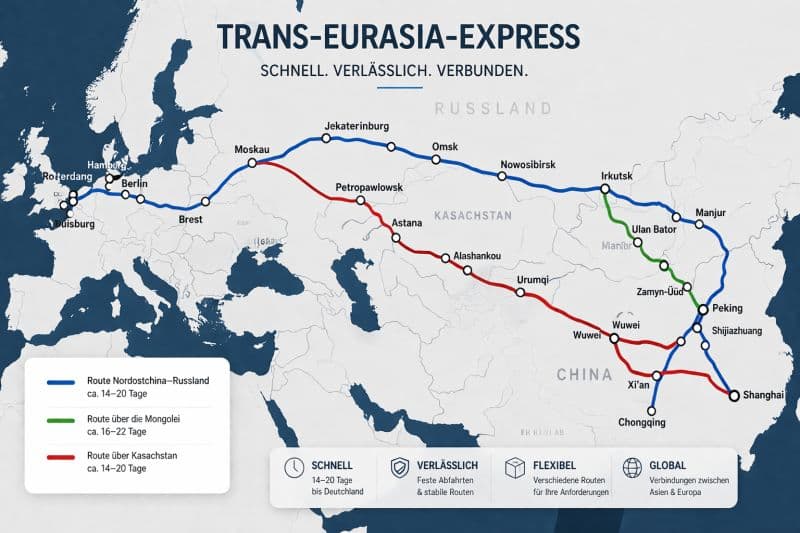
The Trans-Eurasia Express connects China with Europe via various corridors:
- Via Russia
- Via Mongolia
- Via Kazakhstan
In the end, many of these routes converge toward Germany and Central Europe.
This connection offers particularly attractive advantages for certain product categories.
Shorter Transit Times Than Sea Freight
Compared to traditional sea freight, rail transport is significantly faster. This reduces lead times and increases purchasing flexibility.
More Affordable Than Air Freight
When goods are needed quickly but air freight is not economically viable, rail can be an attractive middle-ground solution.
Greater Planning Reliability
Fixed schedules and regular connections often allow for more stable planning.
Suitable for Time-Critical Products
This route is particularly attractive for consumer goods, spare parts, promotional items, or seasonal products.
Despite its advantages, rail transport is not a standard solution for every company.
Key factors to consider include:
Geopolitical Risks
Transit through certain countries has become more complex due to current conflicts.
Insurability
For some route sections, insurance can be more difficult or more expensive to arrange.
Technical Hurdles
At several borders, containers must be reloaded due to different track gauges.
Limited Capacity
Compared to sea freight, the available transport volume is significantly smaller.
Rail transport is particularly suitable when:
- Sea freight is too slow
- Air freight would be too expensive
- Goods are time-critical
- Supply capability must be ensured
- Flexible supply chain solutions are required
However, there is no one-size-fits-all recommendation. Every supply chain must be evaluated individually.
Together with the expertise of Ludwig Häberle Logistik GmbH, we evaluate every transport solution for our clients from a holistic perspective:
- Costs
- Risk
- Transit time
- Availability
- Security of supply
We manage the entire supply chain from a single source and transparently assess whether rail transport is economically viable for each specific project.
The current crises show that companies should not rely exclusively on maritime transport. Rail freight between China and Europe can be a powerful alternative—faster than sea freight, more affordable than air freight, and strategically sensible for many products.
Companies that want to build resilient supply chains need flexible alternatives and experienced partners.