ETA and ETD in logistics: why these terms are often misunderstood
Anyone importing goods from Asia regularly comes across the terms ETA and ETD. At first glance, these two abbreviations may seem precise and reliable. In reality, however, they are often only estimates and should be understood as orientation points rather than fixed delivery dates.
Many companies base their planning on these dates. This can quickly become problematic, because anyone involved in international supply chains knows that there is often a significant gap between the scheduled timeline and the actual arrival of the goods.
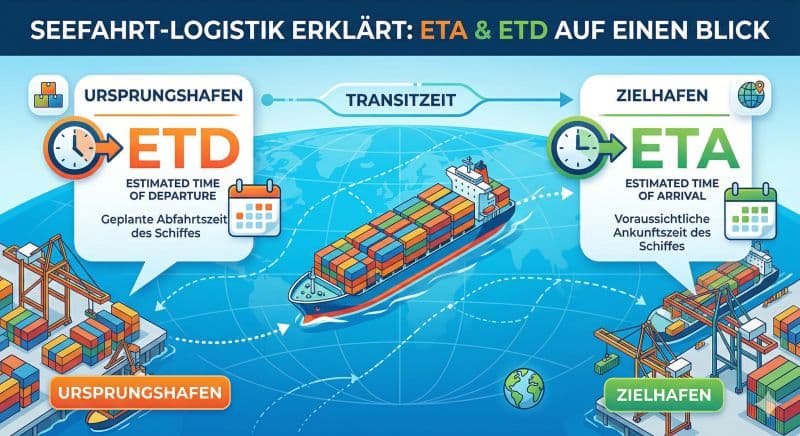
ETA and ETD originate from international transport logistics. ETD stands for “Estimated Time of Departure” and refers to the expected departure time. ETA stands for “Estimated Time of Arrival” and refers to the expected arrival time. In most cases, these terms relate to sea freight, meaning the transport from one port to another. It is important to understand that these are not guaranteed dates, but estimated values.
Especially in maritime trade, there are many factors that neither the importer nor the supplier can directly control. Weather conditions such as storms, high waves, or poor visibility can significantly affect shipping schedules. Port congestion can also lead to delays if vessels have to wait before entering the destination port. Political developments, sanctions, conflicts, or new regulations may also impact international supply chains at short notice. In addition, route changes caused by crisis regions or blocked waterways can considerably extend transit times.
One of the most common misconceptions is equating the ETA with the actual delivery date. This can be risky. When a vessel arrives at the port, the goods are not automatically available at the warehouse or with the customer. After arrival, several additional steps follow, including container unloading, customs clearance, document checks, approvals, onward transport, and delivery scheduling. Depending on the port, country, and current workload, these processes can add several extra days.
The same applies before the actual shipment begins. Before goods are loaded onto a vessel, they usually have to be transported from the factory to the port. Export documents must be prepared, customs clearance in the country of origin has to be completed, containers need to be booked, and the goods must be loaded onto the vessel. Companies that ignore these pre-shipment processes often plan too tightly and underestimate the real lead time.
At Kaiserberg Trading, we therefore look at the entire supply chain rather than focusing only on ETA and ETD. Reliable delivery planning requires an end-to-end perspective, from production at the supplier and pre-carriage in the export country to sea freight, import processing, and onward transport to the final destination. In addition, we include realistic time buffers to better absorb bottlenecks, delays, and unexpected disruptions.
ETA and ETD are important indicators, but they are not guarantees. Companies that import professionally should not rely solely on port-to-port data. Instead, they should consider the complete supply chain in order to create realistic delivery timelines, stable processes, and satisfied customers.
Would you like to make your sourcing from Asia more predictable?
Kaiserberg Trading supports companies with strategic sourcing, import management, and the reliable coordination of international supply chains.